The Continental Detective Story
Fortune Hippolyte Auguste du Boisgobey (1821-1891)
|
Fortune du Boisgobey was, according to Willard Huntington Wright, "a prolific writer of detective fiction, and his work had the undoubted effect of popularizing this type of story in France. Moreover, there is no doubt that he influenced Conan Doyle, if, indeed, Doyle did not go to him for actual suggestions" (The Great Detective Stories). Howard Haycraft calls him "A lesser Gaboriau" and Gaboriau's "avowed disciple": "At his infrequent best he is not unworthy of his acknowledged master" (The Art of the Mystery Story). |
Click Image to  |
Novels to be aware of include:
- Le Crime de l'Opera (mystery, not a detective story)
- Le Forcat Colonel (1872) -- "he [du Boisgobey] followed no continuing detective character through his novels" (The Art of the Mystery Story).
- In Fortune du Boisgobey's The Old Age of Lecoq, du Boisgobey "does honour to his master, Gaboriau, by borrowing his detective" (The Art of the Mystery Story).
Gaston Leroux (1868-1927)
Gaston Leroux's mysteries featured Joseph Rouletabille, reporter, who has appeared in "half a dozen 'adventures extraordinaires.' " Leroux "played religiously fair with his readers," according to Haycraft. Rouletabille has "Sainclair" as his Watson.
- Le Mystere de la Chambre Jaune (1907) (English title: The Mystery of the Yellow Room).
- Only La Parfum de la Dame en Noir (The Perfume of the Lady in Black) approached the popularity of Yellow Room.
|
Click Image to  Click the image below to  |
Click Image to  Click the image below to  |
Willard Huntington Wright writes, "The foremost of the modern French writers of detective fiction is Gaston Leroux; in fact, the half dozen or so novels comprising the Aventures Extraordinaires de Joseph Rouletabille, Reporter are among the finest examples of detective stories we possess." Wright believes Leroux's stories "represent the highest standard reached by the detective novel in France since the literary demise of Lecoq." Here is a list of Leroux's titles (in French and, where possible, English) taken from Willard Huntington Wright's The Great Detective Stories:
- Le Mystere de la Chambre Jaune (The Mystery of the Yellow Room)
- Le Parfum de la Dame en Noir (The Perfume of the Lady in Black)
- Rouletabille che la Tsar (The Secret of the Night)
- Le Chateau Noir
- Les Etranges Noces de Rouletabille
- Rouletabille chez Krupp
- Le Crime de Rouletabille (The Phantom Clue)
Maurice Leblanc (1864–1941)
Maurice Leblanc (11 November 1864 – 6 November 1941) created Arsene Lupin: Gentleman-Cambrioleur (which means "gentleman-burglar") (1907). Charles Henry Meltzer says, "To the skill of Sherlock Holmes and the resourcefulness of Raffles, Arsene Lupin adds the refinement of a casuist, the epigrammatic nimbleness of a Le Rochefoucald and the gallantry of a Du Gueselin."
|
And Willard Huntington Wright writes, "More popular, and certainly more ingenious, though neither as scholarly nor as strictly orthodox, are the famous Arsene Lupin stories of Maurice Leblanc. Lupin in the records of his earlier adventures is a shrewd and dashing criminal -- "un gentleman cambrioleur" -- and therefore quite the reverse of the regulation detective; but he indulges in detective work -- in deductions, in the following of clues, in the subtleties of logic, and in the solution of criminal problems -- which is as brilliant and traditional as that of any fictional officer of the Surete. In his more recent escapades he gives over his anti-legal propensities, and becomes a sleuth wholly allied with the powers of righteousness. Some of the best and most characteristic examples of conventional modern detective stories are to be found in Les Huit Coups de l'Horloge. To the solution of the criminal problems involved in this book Lupin brings not only a keen and penetrating mind, but the fruits of a vast first-hand experience with crime" (The Great Detective Stories). |
Click Image to  Click the image below to  |
Other Lupin titles are:
- The Eight Strokes of the Clock (1922) is reputed to be the best example of Lupin as detective.
- Lupin versus Holmes (I've also seen this titled Arsene Lupin versus Sherlock Holmes.)
|
Click Image to 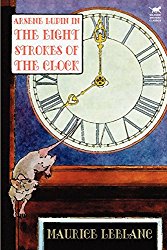 Click the image below to  |
Click Image to 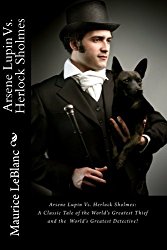 Click the image below to  |
Francois Fosca wrote Histoire et Technique du Roman Policier. (I've seen favorable references by from Ellery Queen about this book but I've been unable to find a copy in English. It seems to be a somewhat important book.)
Pierre Very (1900-1945)is said to be unknown in translation.
Georges Simenon (February 13, 1903 to September 4, 1989) published books about his detective, Inspector Maigret. Haycraft tells us Maigret is a "synthesis of Hanaud, Jim Hanvey, and Inspector Bull" (Murder for Pleasure).
Georges Bernanos (February 20, 1888 to July 5, 1948) produced Diary of My Times.
Claude Aveline (1901) wrote "Inspector Riviere" stories. One or two of these were translated into English but without repeating the success of Maigret.
Maarten Maartens (1858-1915) wrote The Black Box Murder (1889). Haycraft wrote that it's "the only detective story of more than passing note produced by The Netherlands" (Murder for Pleasure). But keep in mind that Haycraft wrote this in the 1940s. The Murder Book by Tage la Cour and Harald Mogensen show that times have changed regarding this statement.
Willard Huntington Wright, later to take the pseudonym S.S. Van Dine and write the famous Philo Vance novels, compiled the anthology The Great Detective Stories (1927). Wright was responsible for putting the detective story back on track at a time when it was declining in popularity -- largely due to bad writing. Wright's doctor forbade him from pursuing his intellectual and scholarly pursuits because of the toll that overwork was taking on his health. While recovering from his illness, Wright couldn't refrain from reading altogether, so he chose material less intellectually challenging than his scholarly pursuits usually entailed. He started to read detective stories.
Wright discovered how poorly written many of the stories of the time were. But they needn't be. He began to write detective novels himself with an eye to producing quality fiction. His efforts elevated the genre, which had started off good but had spiraled downward in quality over years.
Amazon and the Amazon logo are trademarks of Amazon.com, Inc. or its affiliates.

(This is a link through which I make a small commission if you buy. See here for more details.)