Hercule Poirot
"One of the pleasures of writing detective stories is that there are so many types to choose from: the light-hearted thriller, which is particularly pleasant to do; the intricate detective story with an involved plot which is technically interesting and requires a great deal of work, but is always rewarding; and then what I can only describe as the detective story that has a kind of passion behind it -- that passion being to help save innocence. Because it is innocence that matters, not guilt."
-- Agatha Christie in her Autobiography.
The first thing that struck me when I read some short stories about Hercule Poirot was their resemblance to some of Arthur Conan Doyle's plots for Sherlock Holmes. The influence is obvious, as critics and reviewers have pointed out. (Some also point to other fictional influences, including a character named Hercule Popeau, created by Marie Belloc Lowndes.) Christie herself acknowledged that she relied heavily on the Holmes-Watson model during the early stages of learning her craft.
But she developed her talent, her wit, her plots, and Poirot himself, into a series of novels and stories beloved the world over.The Murder of Roger Ackroyd created a furor and divided enthusiasts of the detective story into two distinct camps -- those who cry "Unfair!" versus those who contend that the reader is at fault for failing to discern who the murderer is. After all, one is supposed to suspect everybody. (No, I won't give any spoilers here. If you haven't read it yet I don't want to take away from your pleasure and delight at discovering it.)
|
Click Image to 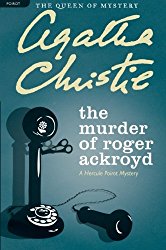 Click the image below to  |
The funny thing is, The Murder of Roger Ackroyd was not the first time Ms. Christie's trick was performed. In "Thou Art the Man," Edgar Allan Poe introduced the trick. Christie herself used it in a previous novel, but it escaped the notice of the reading public. When she tried it again, in The Murder of Roger Ackroyd, readers reacted strongly and a heated debate was on. |
But Agatha Christie didn't stop there. Her list of Hercule Poirot books has become a treasure trove of classics. In Murder on the Orient Express, she created another puzzler in the grand tradition which is a must-read.The Mystery of the Blue Train, Murder in Mesopotamia, Death on the Nile and other books listed below are indispensable. Ms. Christie introduced new tricks to fool aficionados as she quickly ascended to mastery of her craft. Perhaps the biggest mystery is how she was able to consistently take us all in.
|
Click Image to 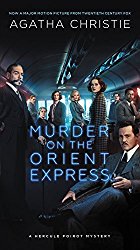 Click the image below to  |
Click Image to 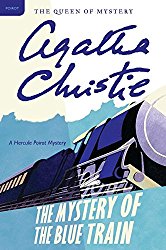 Click the image below to  |
Hercule Poirot is known for using what he calls his "little gray cells" and for his order and method. He is incomparably fussy about his appearance. And he is extremely confident and competent in his deductions. On occasions he has warned someone ahead of time not to follow through with a plan or scheme or relationship. Although we have seen all that he has seen up to that moment, what is obvious to him becomes merely foreshadowing for us. We know that something is amiss because of his response, and that something significant is bound to happen. But we haven't a clue until subsequent developments reveal to us what Poirot has known all along.
|
Click Image to 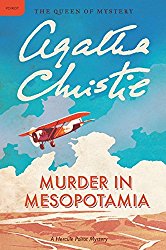 Click the image below to  |
Click Image to 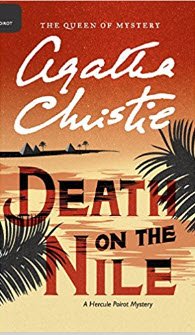 Click the image below to  |
Agatha Christie's Poirot books are a great place to introduce oneself to her detective fiction. Fanatics have been known to become so absorbed in reading her that they have ignored other detectives until they have read everything of hers they can get their hands on.
The Mysterious Affair at Styles (1920)
Murder on the Links (1923)
Poirot Investigates (1924, short stories)
The Murder of Roger Ackroyd (1926)
The Big Four (1927)
The Mystery of the Blue Train (1928)
Peril at End House (1932)
Lord Edgware Dies (1933)
Murder on the Orient Express (1934)
Three Act Tragedy (1935)
Death in the Clouds (1935)
The A.B.C. Murders (1936)
Cards on the Table (1936)
Murder in Mesopotamia (1936)
Death on the Nile (1937)
Dumb Witness (1937)
Murder in the Mews (1937, short stories)
Appointment with Death (1938)
Hercule Poirot's Christmas (1939)
One, Two, Buckle My Shoe (1940)
Sad Cypress (1940)
Evil Under the Sun (1941)
Five Little Pigs (1942)
The Hollow (1946)
The Labours of Hercules (1947)
Taken at the Flood (1948) also published asThere Is a Tide
Mrs. McGinty's Dead (1952)
After the Funeral (1953) also published as Funerals are Fatal
Hickory, Dickory, Dock (1955)
Dead Man's Folly (1956)
Cat Among the Pigeons (1959)
The Clocks (1963)
Third Girl (1966)
Hallowe'en Party (1969)
Elephants Can Remember (1972)
Poirot's Early Cases (1974, short stories)
Curtain (written about 1940, published 1975
|
Click Image to 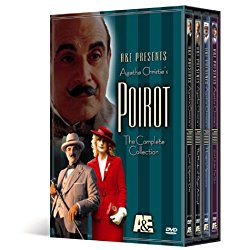 Click the image below to  |
Poirot: The Complete Collection . . . . . . includes all of the performances of David Suchet as Poirot. Mr. Suchet has been called "the perfect Poirot" and "the ultimate Poirot" by reviewers. Highly recommended! |
Amazon and the Amazon logo are trademarks of Amazon.com, Inc. or its affiliates.

(This is a link through which I make a small commission if you buy. See here for more details.)